Smithsonian Institution Archives
  • Collections
  • Services
  • Smithsonian History
  • About
  • Education
  • Blog
  • Forums
  • Press
  • Audiences
  • Donate

The Bigger Picture: Visual Archives and the Smithsonian

Posts tagged with: Conservation

Link Love: 5/31/2013

by Mitch Toda on May 31, 2013

Eric, left, and Ryan Berley serve up handmade jellies, nut clusters, walnut pillows, nonpareils and other goodies at Shane Confectionary, the country's oldest continually operated candy shop. By Chris Crisman.

  • In Part 1 of a series on preserving your family history, Bertram Lyons, an archivist at the American Folklife Center of the Library of Congress, answers questions about preserving audio. [via New York Times]
  • Emulation has come a long way in helping preserve the look, feel, and funcationality of software from the past, but there is still a need to preserve the hardware as well. [via The Signal: Digital Preservation, LOC]
  • Available for free download for archivists: Describing Archives: A Content Standard, Second Edition. [via InfoDocket]
  • The National Archives as well as other federal agencies have been working to implement the Digital Government Strategy by improving digital services to better serve people though mobile apps and web APIs. [via NARAations, NARA]
  • Smithsonian Magazine and Air & Space Magazine are now available in their entirety from Gale Cengage. [via InfoDocket]
  • The people and places across America have so many stories to tell and Smithsonian Magazine offers two:  Shane Confectionery in Philadelphia, Pennsylvania and coffin maker Marcus Daly. [via Smithsonian Magazine]


Categories: What Gets Saved
Tags: American History, Web/Tech, Archive, Link Love, Conservation
Comments: View 8 comments, or Give us yours!
All comments are moderated and subject to approval. Further information is available in The Bigger Picture’s Commenting Guidelines.

Highlight from the Photo Cold Vault: Gelatin Dry Plate Negatives

by Eden Orlove, Contractor, Collections Care Division on May 9, 2013

As a contractor at the Smithsonian Insitution Archives, I work with the photographic collections stored in our cold vault.  Among the various photographic formats found there are a particular type of glass plate negatives; gelatin dry plate negatives.

Invented by Richard Leach Maddox in 1871, gelatin dry plate negatives became the most popular form of negative in use from 1880 to 1900.  Maddox developed a technique to fix a light-sensitive gelatin emulsion to a glass plate.  Previously, photographers used the collodion negative process, which often required them to create portable dark rooms or prepare negatives on site.  Gelatin dry plate negatives utilized different sensitizing, fixing, and development solutions that provided faster exposure times, less toxicity, and a significantly easier and less cumbersome production process.  With the invention of lightweight flexible film, photographers stopped regularly using the gelatin dry plate negative process, although it is still sometimes used today for highly specialized photography , such as the creation of precise astronomical measurements.

A large number of the Smithsonian Institution Archives' holdings of glass plate negatives (which number circa 20,000) are kept in a special storage facility referred to as the cold vault.  The temperature and humidity are controlled and kept low, so when working in the vault it is important to bundle up!

Eden Orelove in the SIA cold vault, 2013

I have been working over the last year to improve the preservation of the glass plate negative collections in the cold vault.  The glass plates have been rehoused in specially designed conservation boxes that provide essential support and padding.

Box of rehoused glass plate negatives, 2013.

While gelatin dry plate negatives tend to have an excellent shelf life, their glass composition makes them fragile.   When I discover a broken negative, I piece it back together, digitize it, create metadata for the image and stabilize it in a sink mat.

Stabilized broken glass plate negative, 2013

The gelatin dry plate negatives in the Archives' collections are a rich historical resource and it is a privilege to know that the work I do to stabilize and rehouse them  will preserve the negatives for future generations.  Be on the look out for my upcoming post that will highlight another photographic format held in the cold vault: lantern slides.

Related Resources

  • What Does a Photograph Archivist Do?, The Bigger Picture blog, Smithsonian Institution Archives
  • Putting It All Together: The Assembly and Rehousing of Glass Plate Negatives, The Bigger Picture blog, Smithsonian Institution Archives
  • Unlocking the Vault, The Bigger Picture blog, Smithsonian Institution Archives

Related Collections

  • Accession 11-006 - United States National Museum, Division of Graphic Arts, Photographic Collection, 1860-1960, Smithsonian Institution Archives
Categories: What Gets Saved
Tags: Archive, Photo History, Conservation
Comments: View 4 comments, or Give us yours!
All comments are moderated and subject to approval. Further information is available in The Bigger Picture’s Commenting Guidelines.

Mounting Photographs with Earth Magnets

by Greta Glaser, Conservation Intern on May 7, 2013

Among the photographic records (Record Unit 95 - Photographic Collection, 1850s- ) at the Smithsonian Institution Archives is a portrait of Charles Greeley Abbot, an American astrophysicist and the fifth secretary of the Smithsonian. The portrait is a photograph of a painting of Abbot, which in turn was painted in reference to an even earlier photograph of Abbot. The photograph is mounted onto a gray board and beneath it is a penciled inscription from the painter – Samantha G. Huntly – dedicating it to Mary Vaux Walcott, the wife of Charles Doolittle Walcott who was the fourth secretary of the Smithsonian.

Portrait of Charles Greeley Abbot, silver gelatin developed-out photograph; the mount is broken in two places along the right edge. By Greta Glaser.At some point in the past the board broke in two places, creating a larger piece containing the photograph and two smaller pieces. Fortunately, the photograph itself survives in stable condition. Sometimes a conservator may consider unmounting the photograph, separating it from the broken board which is no longer offering it the physical support it needs. However, in this case the break runs through the artist's inscription. Separating the photographic portrait of Abbot from the inscription could potentially disassociate it with the inscription, which is what makes it a special and unique object.

All conservation treatments carry various levels of risk. Ultimately it was decided that unmounting the photograph and the facing paper, the frontmost layer of board, with the inscription on it was both a risky and time-consuming treatment in which the benefits did not necessarily outweight the risks at the time. Instead, I decided to create a new housing for the print that would hold it securely to help ensure that no further damage is inflicted on the print or its mount. This way the option to treat the object remains open, should the need ever arise.

The mounted photograph inside its new housing. By Greta Glaser.

The mat was constructed using museum-quality board and earth magnets. Earth magnets are very strong magnets made from rare earth metals, such as neodymium or samarium. They are much stronger than iron magnets, and even tiny earth magnets can have enough attraction to hold several layers of board together. I embedded small earth magnets into the boards in several places and secured them with adhesive. This way the photograph and its mount are held in place with gentle but firm, even pressure. Before the photograph went back into storage in its new housing, I locally consolidated the broken edges of the board with methyl cellulose using a small brush to keep the brittle edges from flaking.

The back of the new housing with signs to indicate where magnets are embedded. By Greta Glaser.

One caution when working with these strong magnets is that they should not come close to electronic or magnetic media, such as cell phones, computers, or VHS tapes. To warn users about the placement of the magnets I pasted small caution signs on the outside of the mat.

A copy of the inscription on the mount; it reads “To Mary Vaux Walcott/ with sincere regards of the painter/ [painted by ->] Samantha G. Huntly". By Greta Glaser.

So viewers can read the inscription on the board without removing it from its protective housing, I pasted a copy of the inscription on the inside flap of the window mat. The photograph is now in climate controlled storage at the Archives and in a more stable housing that will reduce further damage to the inscribed board.

Related Resources

  • How the DAM (Denver Art Museum) Uses Rare-Earth Magents with Art Installations, Denver Art Museum blog

Related Collections

  • Record Unit 95 - Photographic Collection, 1850s- , Smithsonian Institution Archives
Categories: Behind the Scenes
Tags: Archive, Conservation
Comments: View 4 comments, or Give us yours!
All comments are moderated and subject to approval. Further information is available in The Bigger Picture’s Commenting Guidelines.

See Here: 5/6/2013

by Kira M. Cherrix on May 6, 2013
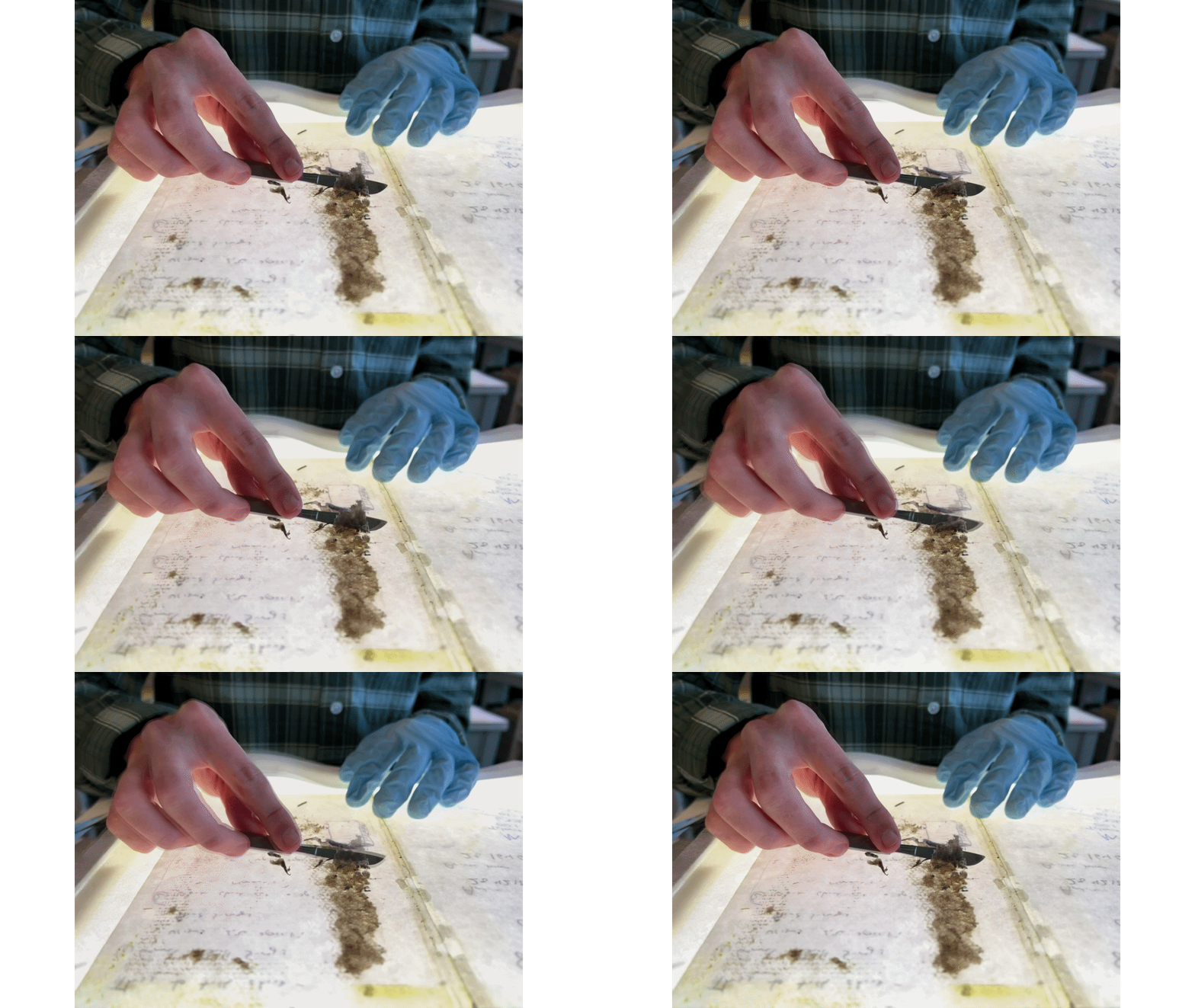
Jane Norman repairing artifact, by Tsantes, John, 1987, Smithsonian Archives - History Div, 2002-32268.
Categories: Collections in Focus
Tags: See Here, Conservation
Comments: View comments, or Give us yours!
All comments are moderated and subject to approval. Further information is available in The Bigger Picture’s Commenting Guidelines.

See Here: 5/3/2013

by Kira M. Cherrix on May 3, 2013
Bactrian Camels at CRC, by Unknown, 1980, Smithsonian Archives - History Div, 96-1017.
Categories: Collections in Focus
Tags: See Here, Conservation
Comments: View comments, or Give us yours!
All comments are moderated and subject to approval. Further information is available in The Bigger Picture’s Commenting Guidelines.
  •  
  • 1 of 28
  • ››

Produced by the Smithsonian Institution Archives. For copyright questions, please see the Terms of Use.

Stay in touch!

Facebook Twitter Flickr YouTube SlideShare
Join our eNewsletter

About

Connecting you to America’s past with a behind-the-scenes exploration of the Smithsonian’s history, treasures, and the challenges that Archives face preserving collections. More details...

Smithsonian on Flickr Commons

Topics/Tags

  • See Here (614)
  • American History (553)
  • Science (437)
  • Archive (338)
  • Cities/Places (282)
  • Exhibitions (236)
  • Web/Tech (215)
  • Photo History (190)
  • Link Love (157)
  • Politics/Government (154)

Blog Roll

All Smithsonian blogs
American Historical Association Blog
American Institute of Conservation Blog
Archives Next
Archives of American Art
Around the Mall
Field Book Project
Hanging Together
Library of Congress Blogs
National Archives (US) Blogs
National Museum of American History, O say can you see?
Smithsonian Collections Blog
Smithsonian Libraries
Teaching American History

Categories

  • Collections in Focus (1002)
  • What Gets Saved (342)
  • Behind the Scenes (213)
  • Smithsonian History (141)

Recent Posts

  • Women in Science Wednesday: Constance Endicott Hartt
  • Mr. Rogers at the Zoo
  • Sneak Peek 6/17/2013
  • Link Love: 6/14/2013
  • Summertime on the Mall - Smithsonian Folklife Festival

Monthly Archive

  • June 2013 (14)
  • May 2013 (32)
  • April 2013 (26)
  • March 2013 (26)
  • February 2013 (26)
  • January 2013 (28)
  • December 2012 (26)
  • November 2012 (28)
  • October 2012 (32)
  • September 2012 (26)
  • August 2012 (31)
  • July 2012 (26)
  • June 2012 (27)
  • May 2012 (27)
  • April 2012 (27)
  • March 2012 (28)
  • February 2012 (27)
  • January 2012 (26)
  • December 2011 (31)
  • November 2011 (28)
  • October 2011 (35)
  • September 2011 (31)
  • August 2011 (35)
  • July 2011 (41)
  • June 2011 (43)
  • May 2011 (33)
  • April 2011 (40)
  • March 2011 (43)
  • February 2011 (35)
  • January 2011 (36)
  • December 2010 (42)
  • November 2010 (40)
  • October 2010 (44)
  • September 2010 (37)
  • August 2010 (39)
  • July 2010 (38)
  • June 2010 (37)
  • May 2010 (42)
  • April 2010 (44)
  • March 2010 (47)
  • February 2010 (40)
  • January 2010 (39)
  • December 2009 (43)
  • November 2009 (34)
  • October 2009 (11)
  • September 2009 (11)
  • August 2009 (12)
  • July 2009 (14)
  • June 2009 (10)
  • May 2009 (12)
  • April 2009 (14)
  • March 2009 (10)
  • January 2009 (1)
Smithsonian Institution Archives
eNewsletter Facebook Twitter Flickr Historypin YouTube SlideShare Browsealoud
Smithsonian Institution
  • Privacy
  • Copyright
  • Contact